
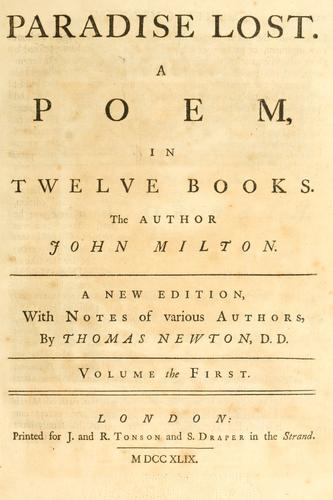
John Milton's Paradise Lost is one of the greatest epic poems in the English language. It tells the story of the Fall of Man, a tale of immense drama and excitement, of rebellion and treachery, of innocence pitted against corruption, in which God and Satan fight a bitter battle for control of mankind's destiny. The struggle rages across three worlds - heaven, hell, and earth - as Satan and his band of rebel angels plot their revenge against God. At the center of the conflict are Adam and Eve, who are motivated by all too human temptations but whose ultimate...
John Milton's Paradise Lost is one of the greatest epic poems in the English language. It tells the story of the Fall of Man, a tale of immense drama and excitement, of rebellion and treachery, of innocence pitted against corruption, in which God and Satan fight a bitter battle for control of mankind's destiny. The struggle rages across three worlds - heaven, hell, and earth - as Satan and his band of rebel angels plot their revenge against God. At the center of the conflict are Adam and Eve, who are motivated by all too human temptations but whose ultimate downfall is unyielding love. Marked by Milton's characteristic erudition, Paradise Lost is a work epic both in scale and, notoriously, in ambition. For nearly 350 years, it has held generation upon generation of audiences in rapt attention, and its profound influence can be seen in almost every corner of Western culture.
Paradise Lost: The Epic Struggle of Heaven, Hell, and Earth 🌌🔥
John Milton’s Paradise Lost stands as one of the most remarkable epic poems in the English language, weaving a story of immense drama, rebellion, and the complexities of human and divine experience. At its core, the poem tells the story of the Fall of Man, exploring the tension between innocence and corruption, obedience and rebellion, love and ambition. Across three realms — heaven, hell, and earth — Milton portrays a universe in turmoil, where choices, temptations, and consequences resonate with timeless power.
The Rebellion of Satan and the War in Heaven 👿⚡
The epic opens with the aftermath of a celestial conflict, where Satan and his band of rebel angels are cast out of heaven after challenging God’s authority. Milton presents Satan not simply as a villain, but as a complex figure, full of ambition, pride, and defiance. His charisma, intelligence, and eloquence make him a captivating character, even as he plots revenge against the Creator. The rebellion sets the stage for the cosmic struggle, illustrating themes of free will, power, and consequence.
In hell, Satan rallies his followers, constructing a council of the damned to strategize their vengeance. The imagery of hell is both terrifying and awe-inspiring, capturing the enormity of the spiritual conflict. Here, Milton explores the allure of ambition, the corruption of pride, and the consequences of turning away from divine order.
Adam and Eve: Innocence and Temptation 🌿🍎
On earth, Adam and Eve embody human innocence and the vulnerabilities of the human spirit. Milton portrays them as deeply human, capable of love, curiosity, and the struggle to navigate moral choices. Their life in Eden is idyllic, yet the freedom they enjoy comes with responsibility. The subtle introduction of temptation through Satan’s schemes demonstrates how easily virtue can be tested.
As the narrative unfolds, the tension between obedience and desire becomes central. Eve’s encounter with Satan, disguised and persuasive, introduces doubt and ambition, leading to her eventual choice to partake of the forbidden fruit. Adam, motivated by love and solidarity, follows her, marking the moment of the Fall. Milton’s depiction of their decision emphasizes the profound human themes of choice, accountability, and the consequences of yielding to temptation.
The Cosmic Struggle Across Three Worlds 🌌🌍🔥
| World | Key Characters | Conflict and Theme |
|---|---|---|
| Heaven | God, angels, rebel angels | Order versus rebellion, divine authority and obedience |
| Hell | Satan, rebel angels | Revenge, pride, ambition, and the consequences of defiance |
| Earth | Adam, Eve, Satan | Innocence, temptation, free will, and the human condition |
Milton’s Vision and Literary Brilliance ✨📜
Paradise Lost is as notable for its literary grandeur as for its narrative. Milton’s erudition is evident in the poem’s elevated style, intricate structure, and poetic devices. From the lofty descriptions of celestial battles to the intimate depiction of Adam and Eve’s emotions, the work demonstrates Milton’s skill in blending epic storytelling with profound philosophical and theological reflections.
The poem’s influence extends far beyond its immediate story. Themes of free will, moral choice, ambition, and redemption have echoed through centuries of literature, art, and culture. Iconic elements, such as Satan’s complex character and the portrayal of Eden, have shaped how generations imagine the tension between good and evil.
Lessons and Reflections 🌿⚖️
At its heart, Paradise Lost is a meditation on human nature and divine order. The poem encourages reflection on choices, consequences, and the moral responsibility inherent in freedom. Through the struggles of Adam and Eve, and the rebellion of Satan, Milton illustrates the enduring challenges of pride, desire, and obedience, and the profound costs of yielding to temptation.
Milton also emphasizes the power of redemption and hope. Even in the wake of the Fall, the narrative suggests the possibility of learning, growth, and reconciliation, reminding readers that even in loss, there is a path toward understanding and restoration.
Enduring Impact and Legacy 🌌🕊️
For over three centuries, Paradise Lost has captivated audiences with its epic scope, rich language, and timeless themes. Its influence is felt in literature, art, philosophy, and culture. From dramatic retellings to modern interpretations, the poem continues to inspire reflections on morality, courage, love, and the human spirit.
Milton’s work reminds readers that the struggle between light and darkness, order and chaos, innocence and temptation is not only a cosmic story but also a reflection of human experience. Paradise Lost remains an enduring testament to imagination, intellect, and the profound complexity of existence. 🌟📖