
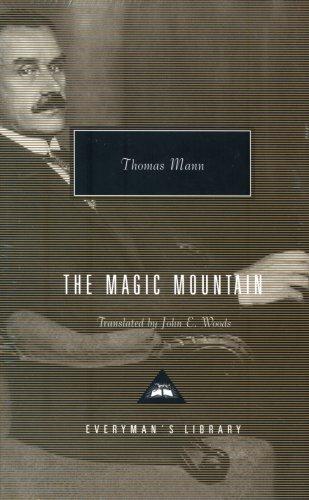
One of the most influential and celebrated German works of the 20th century has been newly rendered in English by Woods, twice winner of the PEN Translation Prize. First published in 1929, Mann's novel tells the story of Hans Castorp, a modern everyman who spends seven years in an Alpine sanatorium for tuberculosis patients, finally leaving to become a soldier in World War I. Isolated from the concerns of the everyday world, he is exposed to the wide range of ideas that shaped a world on the verge of explosion. Considering what was to follow, the most poignant moment comes...
One of the most influential and celebrated German works of the 20th century has been newly rendered in English by Woods, twice winner of the PEN Translation Prize. First published in 1929, Mann's novel tells the story of Hans Castorp, a modern everyman who spends seven years in an Alpine sanatorium for tuberculosis patients, finally leaving to become a soldier in World War I. Isolated from the concerns of the everyday world, he is exposed to the wide range of ideas that shaped a world on the verge of explosion. Considering what was to follow, the most poignant moment comes when Naphta, a Jewish-born Jesuit, defends the use of terror and the taking of life for the sake of an all-encompassing idea. Woods's work reads more naturally than the original translation, which, while faithful to the German, was stiff and forbidding. A necessary addition to any fiction collection.
Der Zauberberg 🏔️📘
Der Zauberberg stands as one of the most thoughtful and challenging novels of the twentieth century. Written by Thomas Mann this work is not simply a story but a deep exploration of time illness belief and the fragile state of modern civilization. Through calm reflection and intellectual tension the novel draws the reader into a world removed from ordinary life yet closely connected to the forces that shaped history.
The narrative follows Hans Castorp a young engineer who travels to an Alpine sanatorium to visit a sick relative. What begins as a short visit slowly stretches into seven long years. Within the walls of the mountain retreat Hans becomes separated from the rhythms of ordinary society. Days blend together seasons pass quietly and time itself seems to lose meaning. This slow drifting is not accidental. It mirrors the inner journey of a man who is learning to question everything he once assumed was fixed.
The Mountain as a World Apart ⛰️
The sanatorium is more than a medical facility. It is a symbolic space where ordinary rules no longer apply. Patients live according to routines shaped by illness and rest rather than work or ambition. Conversations linger over meals and long hours are spent observing small changes in health or weather. In this suspended world Hans Castorp encounters ideas that challenge his earlier simplicity.
Life on the mountain encourages reflection. Removed from the urgency of cities the characters examine philosophy politics art and morality. Illness becomes a lens through which existence is reconsidered. The body weakens while the mind grows restless. Mann uses this setting to show how isolation can sharpen thought while also blurring moral boundaries.
Hans Castorp as a Modern Figure 👤
Hans Castorp does not arrive as a hero. He is ordinary curious and unformed. His strength lies in his openness. He listens more than he speaks. He absorbs arguments and emotions from those around him. Over time he becomes a reflection of the era itself shaped by conflicting forces and unresolved questions.
His prolonged stay changes him deeply. He becomes accustomed to illness and delay. Ambition fades and contemplation takes its place. This transformation is subtle yet profound. Mann presents growth not as a sudden awakening but as a gradual reshaping of awareness.
Ideas in Conflict 💭⚔️
The intellectual heart of Der Zauberberg lies in the debates between its characters. Each voice represents a worldview struggling for dominance. Some argue for reason science and progress. Others defend faith authority and absolute belief. Hans stands between them uncertain yet attentive.
One of the most unsettling moments involves Naphta. A man shaped by discipline and ideology he argues that violence can be justified in service of an all embracing idea. His words carry chilling weight especially when viewed through the shadow of the coming war. Mann does not present these arguments lightly. He allows them to unfold slowly forcing the reader to confront their implications.
Time Illness and Meaning ⏳🫁
Time behaves strangely on the mountain. Days feel endless yet years pass unnoticed. Mann explores this distortion carefully. Illness stretches moments and dulls urgency. The patients measure life in symptoms rather than achievements.
This altered sense of time becomes a philosophical question. What is a meaningful life when progress is paused. What remains when productivity fades. Der Zauberberg suggests that reflection itself may be a form of purpose even if it leads to discomfort.
Language and Translation 📖
The English rendering by Woods brings renewed life to the novel. His version flows with clarity while preserving the depth of Mann’s prose. Earlier translations often felt distant and rigid. This newer approach allows the emotional and intellectual layers to emerge more naturally.
Through this translation modern readers can experience the novel as a living conversation rather than a distant classic. The ideas feel immediate and relevant despite the historical setting.
Moments That Define the Journey ✨
| Stage | Experience | Effect on Hans |
|---|---|---|
| Arrival | Short visit to the sanatorium | Curiosity and detachment |
| Prolonged Stay | Life shaped by illness | Loss of ordinary ambition |
| Intellectual Conflict | Exposure to extreme ideas | Inner questioning |
| Departure | Return to the world through war | Uncertain maturity |
The Shadow of History 🌍
The novel gains power from what lies beyond its pages. As Hans eventually leaves the mountain he enters a world on the brink of catastrophe. World War I looms as an unavoidable force. The quiet debates of the sanatorium give way to violence and chaos.
This transition is deeply moving. The reader understands that reflection alone cannot prevent destruction. Ideas discussed in comfort are tested brutally in reality. Mann captures this tragic shift with restraint and depth.
Why Der Zauberberg Endures 🌟
Der Zauberberg remains vital because it refuses simple answers. It does not tell the reader what to think. Instead it invites patience and thought. It mirrors the confusion of a world struggling between reason and fanaticism.
The novel speaks to anyone who has felt suspended between stages of life uncertain of direction yet aware that change is inevitable. It reminds us that ideas have consequences and that reflection without compassion can become dangerous.
In the end Der Zauberberg is not only about illness or philosophy. It is about humanity standing on the edge of transformation. Its quiet intensity continues to resonate offering insight into the fragile balance between thought belief and action 🌌